Bachelor of Science in Electronics Engineering
About the Program
INSTITUTIONAL VISION
FEU Pampanga envisions itself as a leading industry-driven educational institution in Region III, bridging academic excellence and industry expertise to produce competitive, job-ready graduates
INSTITUTIONAL MISSION
FEU Pampanga is committed to providing innovative, high-quality, and industry-relevant education that fosters excellence, integrity, and social responsibility. By combining academic rigor with hands-on experience, we ensure our graduates are fully equipped to meet the needs of the modern workforce.
VISION
The Electronics Engineering Department of FEU Pampanga envisions itself as a preferred provider of quality electronics engineering education in Region III producing innovative and industry-ready Electronics Engineers equipped with dynamic technical expertise, ethical leadership, and a commitment to societal advancement.
MISSION
The Electronics Engineering Program of FEU Pampanga is committed to:
Strengthening partnerships with industry leaders, professional organizations, and the community to enhance student employability, innovation, and social responsibility.
Offering a dynamic, industry-relevant curriculum that cultivates technical expertise, critical thinking, and ethical engineering practices;
Promoting faculty excellence through continuous professional development, research, and industry engagement;
Providing cutting-edge facilities and hands-on learning experiences to equip students for the evolving global workforce; and
-
FEU Pampanga Admissions Office
FEU Pampanga Campus, MacArthur Hwy, San Fernando City, 2000 Pampanga
+63917 126 6519
admission@feupampanga.edu.ph

Output-Based Education (OBE)
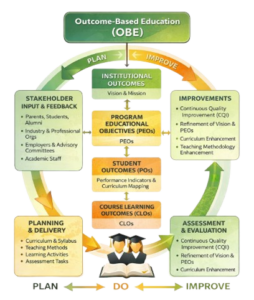
This Framework presents Outcome-Based Education (OBE) as a continuous Plan–Do–Improve system that aligns FEU Pampanga’s vision and mission down to classroom instruction. Institutional Outcomes define the desired graduate attributes, which are translated into Program Educational Objectives (PEOs) and then into measurable Program Outcomes (POs) achieved at graduation. These are further broken down into Course Learning Outcomes (CLOs) that guide teaching, learning activities, and assessments. Through systematic planning and delivery, assessment and evaluation, and strong stakeholder feedback, the framework ensures continuous quality improvement (CQI). It guarantees constructive alignment, industry relevance, and the production of competent, ethical, and globally competitive engineering graduates.
PROGRAM EDUCATIONAL OBJECTIVES (PEOs)
Within 3 to 5 years after graduation, the program expects that:
| PEO 1 | Graduates shall be engaged in the professional practice of Electronics Engineering in accordance with Republic Act No. 9292, securing gainful employment and contributing to technological innovation and national development.
|
| PEO 2 | Graduates shall uphold professionalism, ethical responsibility, leadership, and teamwork while complying with applicable laws, industry standards, and regulatory requirements in local and global engineering environments.
|
| PEO 3 | Graduates shall pursue lifelong learning through continuous professional development, including advanced training, professional certification, postgraduate education, and research, to maintain competence amid technological advancements.
|
| PEO 4 | Graduates shall apply Electronics Engineering knowledge and modern tools to solve real-world problems and participate in community service and sustainable development initiatives in the interest of public welfare. |
Relationship of the Program Educational Objectives to the Vision-Mission:
|
PEO |
Mission | |||
| A | B | C |
D |
|
| PEO1 |
✓ |
✓ | ✓ |
✓ |
| PEO2 |
✓ |
✓ | |
✓ |
| PEO3 |
|
✓ | ✓ |
|
| PEO4 |
|
✓ |
✓ |
|
Program Outcomes
Relationship of the Program Outcomes to the Program Educational Objectives:
| A. COMMON PROGRAM OUTCOMES | 1 | 2 | 3 | 4 | |
| a. | Articulate and discuss the latest developments in the specific field of practice. | ✓ | |||
| b. | Effectively communicate orally and in writing using both English and Filipino. | ✓ | |||
| c. | Work effectively and independently in multi-disciplinary and multi-cultural teams. | ✓ | |||
| d. | Act in recognition of professional, social and ethical responsibility. | ✓ | |||
| e. | Preserve and promote “Filipino historical and cultural heritage”. | ✓ | |||
| f. | Apply professional skills in research in a specialized field of discipline. | ✓ | ✓ | ||
| B. COMMON TO INSTITUTIONAL COURSES | 1 | 2 | 3 | 4 | |
| a. | Articulate ideas in an understandable and appreciable manner based on social setting. | ✓ | |||
| b. | Create arguments based on reliable and appropriate evidence. | ✓ | |||
| c. | Analyze issues through interdisciplinary lenses and with consideration to different contexts. | ✓ | |||
| d. | Reflect on one’s position in issues concerning the self and society. | ✓ | |||
| e. | Propose evidence-based fair actions and alternative solutions which are sustainable to address micro- and macro-scale societal problems. | ✓ | |||
| f. | Challenge present societal systems through thought-provoking questions. | ✓ | |||
| g. | Respond to the needs of the community through transformational leadership. | ✓ | |||
| h. | Disseminate information evaluated through ethical, responsible, and conscientious standards. | ✓ | |||
| i. | Demonstrate commitment in accomplishing tasks in a precise and punctual manner. | ✓ | ✓ | ||
| C. SPECIFIC TO ELECTRONICS ENGINEERING
At the time of graduation, BS Electronics Engineering program graduates should be able to: |
1 | 2 | 3 | 4 | |
| a. | Apply knowledge of mathematics and sciences to solve engineering problems. | ✓ | ✓ | ✓ | ✓ |
| b. | Design and conduct experiments, as well as to analyze and interpret data. | ✓ | ✓ | ✓ | ✓ |
| c. | Design a system, component, or process to meet desired needs within realistic constraints such as economic, environmental, social, political, ethical, health and safety, manufacturability, and sustainability, in accordance with standards. | ✓ | ✓ | ✓ | ✓ |
| d. | Function on multidisciplinary teams. | ✓ | ✓ | ✓ | ✓ |
| e. | Identify, formulate, and solve engineering problems. | ✓ | ✓ | ✓ | ✓ |
| f. | Apply professional and ethical responsibility. | ✓ | ✓ | ✓ | ✓ |
| g. | Communicate effectively. | ✓ | ✓ | ✓ | ✓ |
| h. | Identify the impact of engineering solutions in a global, economic, environmental, and social context. | ✓ | ✓ | ✓ | ✓ |
| i. | Recognize the need for, and an ability to engage in life-long learning. | ✓ | ✓ | ✓ | ✓ |
| j. | Apply knowledge of contemporary issues. | ✓ | ✓ | ✓ | ✓ |
| k. | Use techniques, skills, and modern engineering tools necessary for engineering practice. | ✓ | ✓ | ✓ | ✓ |
| l. | Apply knowledge and understanding of engineering and management principles as a member and leader in a team, to manage projects and in multidisciplinary environments. | ✓ | ✓ | ✓ | ✓ |
| m. | Understand at least one specialized filed of Electronics Engineering practice. | ✓ | ✓ | ✓ | ✓ |
Career Pathways
- Electronics and Communications Engineer – designing and maintaining communication systems, antennas, and networks.
- Broadcast and Network Engineer – working in radio, TV, and digital broadcasting systems.
- Semiconductor and Microelectronics Engineer – involved in the design, testing, and production of integrated circuits and chips.
- Control and Automation Engineer – developing systems for industrial automation and robotics.
- Embedded Systems Engineer – working on hardware-software integration for smart devices and IoT systems.
- Signal Processing Engineer – specializing in audio, video, and data signal analysis.
- Aerospace and Defense Electronics Engineer – designing navigation, radar, and avionics systems.
- Academician/Researcher – teaching or conducting research in electronics and communication engineering fields.
- Entrepreneur/Technopreneur – starting businesses in electronics design, manufacturing, or IT services.
Licenses
- Electronics Technician (ECT)
- Electronics Engineer (ECE)
- Professional Electronics Engineer (PECE)
Certifications
- BOSH Safety Officer (SO2)
- Cisco Certifications (CCNA, CCNP, CCIE)
- Juniper Networks Certification
- 5G Technology Certifications
- IPC Certifications (IPC-A-610, IPC-7711/21, etc.)
- Certified LabVIEW Developer (CLD)
- Certified Engineering Technician in Testing & Measurement
- Siemens Certified Automation Engineer
- CompTIA Certifications (A+, Network+, Security+)
- Certified Information Systems Security Professional (CISSP)
- Certified Lean Six Sigma Belt (White, Yellow, Green, Black, Master Black)”
Curriculum (Approved 2025-2026)
| Course | Units |
|---|---|
| General Education Courses | 36 units |
| NSTP | 6 units |
| PATHFIT | 8 units |
| Basic Courses | 25 units |
| Technical Courses | 12 units |
| Natural/Physical Sciences | 6 units |
| Basic Engineering Sciences | 9 units |
| Allied Courses | 20 units |
| Professional Core Courses | 61 units |
| Electives / Specialization Courses | 8 units |
| Total: 171 units | |
